Shell Information Technology International B.V. is extending its collaboration with C3 AI under a new multi-year agreement covering Shell’s global operations.
Under the new agreement, Shell will extend its use of C3 AI Reliability beyond equipment anomaly detection. The company will also introduce AI agent-based root cause analysis and remediation across its asset operations.
Shell uses C3 AI Reliability to support equipment monitoring and predictive maintenance. The expanded programme also uses the C3 Agentic AI Platform.
The deployment runs on Microsoft Azure and forms part of Shell’s enterprise-scale reliability programme.
The expanded deployment is intended to support root cause analysis and remediation after abnormal equipment behaviour is detected.
Shell builds on earlier deployment
The agreement builds on a predictive maintenance programme that C3 AI and Shell have operated since 2018. The programme monitors more than 13,000 pieces of equipment across Shell’s asset base.
Shell’s work with C3 AI began several years before the latest agreement. In 2018, Shell selected the C3 Platform on Microsoft Azure for AI applications, with predictive maintenance among the first use cases.
Microsoft said at the time that Shell planned to apply the technology to hundreds of thousands of critical pieces of equipment globally.
By 2022, C3 AI said Shell had scaled the programme to monitor and maintain more than 10,000 pieces of equipment. The deployment covered upstream, manufacturing, and integrated gas assets.
In 2023, C3 AI said its Reliability application would incorporate predictive maintenance technology developed by Shell. C3 AI also said Shell had more than 10,000 pieces of equipment from tens of assets monitored on the C3 AI ecosystem.
Downtime remains a cost issue
Deloitte has estimated that unplanned downtime costs industrial manufacturers about US$50 billion each year. Deloitte has also said poor maintenance strategies can reduce plant productive capacity by 5% to 20%.
Predictive maintenance systems use IoT sensors and connected devices to collect asset data. IBM says that data is analysed using AI and machine-learning algorithms to identify changes in operating conditions and performance.
MarketsandMarkets expects the predictive maintenance market to grow from US$13.89 billion in 2026 to US$23.79 billion by 2031. Its forecast covers monitoring infrastructure such as sensors, imaging and inspection devices, edge monitoring, and connectivity hardware.
The forecast also includes IIoT, digital twins, and AI-driven predictive models.
Azure supports the deployment
The deployment is supported by Microsoft Azure. Sandy Gupta, VP GISV, Software Development Companies at Microsoft, said the work between Shell and C3 AI has involved production applications running on cloud infrastructure over several years.
C3 AI said Shell’s predictive maintenance programme runs across global operations. Stephen Ehikian, President of C3 AI, said Shell has built mature AI predictive maintenance programmes on the company’s platform.
Ehikian also said the companies are extending the work into agentic AI.
The latest agreement adds AI agent-based root cause analysis and remediation to Shell’s existing reliability workflows across global asset operations.
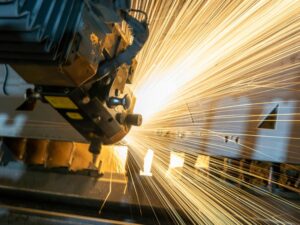
(Photo by Emmanuel Ikwuegbu)
See also: NVIDIA NemoClaw AI agents automate industrial engineering

Want to learn more about IoT from industry leaders? Check out IoT Tech Expo taking place in Amsterdam, California, and London. The comprehensive event is part of TechEx and is co-located with other leading technology events, click here for more information.
IoT News is powered by TechForge Media. Explore other upcoming enterprise technology events and webinars here.